AUSTRALIA · STATE & TERRITORY CAMPAIGNS
State and territory campaign websites your team can maintain.
Give your candidate profile, priorities and campaign updates a clear home. PoliticalWin's guided pages let you use the institution, office and electoral-area wording your campaign needs.
English website $39 USD/month No setup fee
For state parliamentary and ACT or Northern Territory Legislative Assembly candidates. Identify the chamber and the district, division, region or statewide candidacy that applies.
- State parliament candidates
- Legislative Council
- ACT Assembly
- Northern Territory Assembly
Campaign website essentials
What should a state or territory candidate website make clear?
Identify the candidate, parliament or assembly, chamber and relevant electoral area. Explain the background and priorities in the context of that institution's responsibilities. Australian states and territories use different chamber names and electoral arrangements, so one copied district description will not fit every campaign. PoliticalWin provides flexible profile wording, issue pages, updates and forms; your team supplies and reviews the election-specific details.
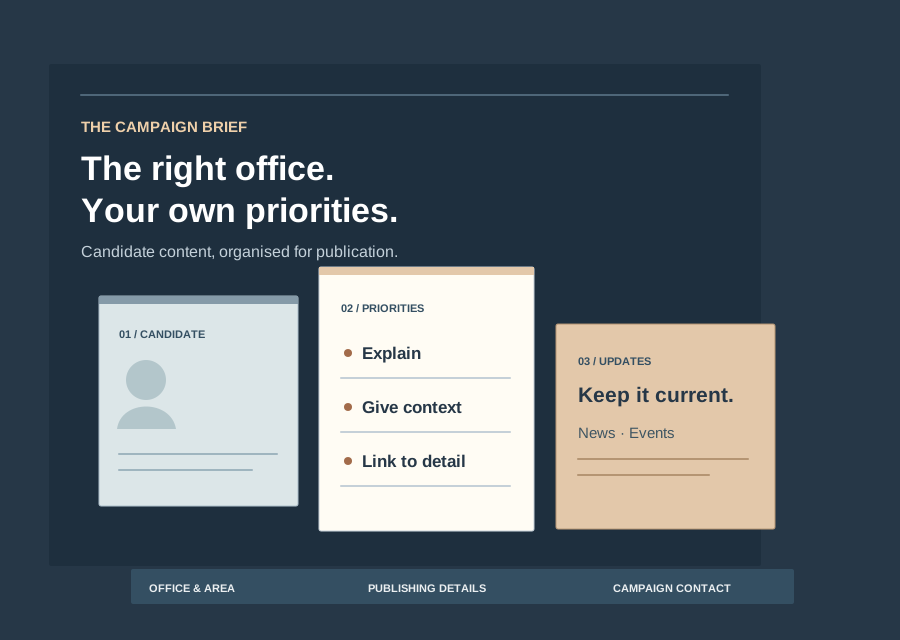
A clear campaign brief
One publishing structure, several different institutions.
The office and electoral-area wording is yours to enter. Country settings adapt location fields; they do not configure an electoral system or a parliament's powers.
LOWER-HOUSE CAMPAIGNS
Name the house and electoral area
Use Legislative Assembly or House of Assembly as appropriate, with the current district or division. Avoid assuming that every lower-house electorate elects just one member; Tasmania's House of Assembly uses multi-member divisions.
LEGISLATIVE COUNCIL
Give an upper-house campaign its own context
Use the current electoral area for your state. Victoria uses regions, Western Australia now uses a whole-of-state Council electorate, and Tasmania uses individual Council divisions. Check the relevant authority for the details.
TERRITORY ASSEMBLIES
Include ACT and Northern Territory candidates
Identify the Legislative Assembly and the correct electorate or division. The ACT Assembly also covers local government functions, so its campaigns need territory context rather than a separate council template.
PUBLIC PARTICIPATION
Contact and volunteer interest in one place
Give visitors a clear way to contact the campaign or express interest in helping. Australian state and territory options support location details; postcodes remain optional and can be hidden entirely.
From draft to public page
Build around the institution, then develop the detail.
A well-organised campaign site can hold both a concise introduction and fuller policy explanations. The structure stays consistent while the content reflects your actual candidacy.
Set the campaign identity precisely
Name the parliament or assembly and use the correct chamber and office title. Check whether your candidacy is for a district, division, region or statewide electorate before adding the location wording.
Explain priorities at the right level
Use an overview for the main themes and separate issue pages for detail. Relate proposals to the relevant state or territory responsibilities, with approved external resources where useful.
Keep review and publication practical
Prepare the text and photographs your campaign has reviewed, then publish news and events through guided fields. Recheck public contact, authorisation and external links as rules or campaign details change.
Prepare your first edition
A useful review sequence before your site goes public.
Confirm the institutional details first, then prepare the pages and check that the product meets your campaign's practical requirements.
Confirm your current electoral area
Use the relevant electoral authority to check the chamber, office, boundaries and area name. Keep proposed redistributions separate from boundaries in force for your contest.
Resolve language and data requirements
Choose from the current English, Spanish and English/Spanish options. Confirm any other language, Australian hosting or data-residency requirement with support before signup.
Prepare the candidate and policy pages
Add a biography, photographs and a concise priorities overview, then develop issue pages, campaign news and events through the dashboard.
Review the public information
Check your election's current authorisation and funding guidance, the privacy text, external links and forms. Review mobile and desktop pages before sharing the address.
Before you choose
The practical details, clearly stated.
- Different rules need current sources
- State and territory requirements can differ from federal and local rules. The editable footer field helps publish your reviewed text; it is not an automatic election-law check.
- Budget in USD
- Current public prices are in US dollars. Review the selected plan and any separate domain or external-service costs before checkout.
- Check the language fit early
- Current native publishing supports English, Spanish and English/Spanish. It does not include other Australian community languages or Aboriginal and Torres Strait Islander languages.
Useful answers
Questions before you start.
Check the website features, publishing options and campaign responsibilities.
Can candidates across all Australian states and territories use it?
Yes. The profile accepts your own office and electoral-area wording, so it can support state parliamentary campaigns and ACT or Northern Territory Assembly campaigns. Select Australia and the appropriate state or territory, then identify the institution and candidacy accurately. The platform does not administer nominations or election results.
Can I use MP, MLA, MLC or another local office title?
Yes. Enter the title your jurisdiction uses in the office field and name the chamber where useful. The label is flexible; PoliticalWin does not determine which parliamentary title or electoral area applies to your candidacy.
Does an upper-house campaign have to use a district?
No. The relevant area differs by state. Victoria's Legislative Council uses regions, WA uses a whole-of-state electorate, NSW and South Australia elect Council members statewide, and Tasmania uses Council divisions. Queensland, the ACT and the Northern Territory have no upper house. Check current official guidance for your election.
Can an ACT campaign cover local issues on this website?
Yes. The ACT Legislative Assembly combines territory and local government functions; the ACT has no separate local councils. An Assembly candidate can explain the relevant priorities through the website's issue pages while identifying the institution and electorate clearly.
Does the platform handle state election authorisations and donations?
It provides an editable footer disclaimer field and an external donation URL. Your campaign supplies reviewed authorisation wording and chooses any donation service. PoliticalWin does not certify legal compliance, process political donations, check donor eligibility, or prepare funding and disclosure returns.
Can we publish in community or First Nations languages?
The current native publishing options are English, Spanish and English/Spanish. Other community languages and Aboriginal and Torres Strait Islander languages are not currently supported as native publishing options. Resolve any essential language requirement with support before choosing a plan; the bilingual plan specifically means English and Spanish.
A home for your campaign
Start with a website that reflects your candidacy.
Confirm the institution and product fit, explore the designs and begin organising your campaign pages.